


Page 58 - 2025S
P. 58
UEC Int’l Mini-Conference No.54                                                               51


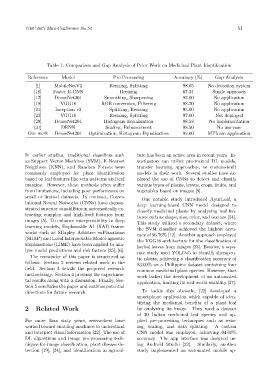
                      Table 1: Comparison and Gap Analysis of Prior Work on Medicinal Plant Identification

             Reference      Model                  Pre-Processing             Accuracy (%)       Gap Analysis
                 [1]     MobileNetV2              Resizing, Splitting             98.05      No detection system
                [10]     Faster R-CNN                 Resizing                    67.34        Single approach
                [17]     DenseNet201           Smoothing, Sharpening              93.00         No application
                [18]        VGG16             RGB conversion, Filtering           98.70         No application
                [21]      Inception v3            Splitting, Resizing             95.00         No application
                [23]        VGG16                 Resizing, Splitting             97.00          Not deployed
                [29]     DenseNet201           Histogram Equalization             98.58       No implementation
                [31]        DENN                Scaling, Enhancement              98.50          No use-case
             Our work    DenseNet201    Optimization, Histogram Equalization      99.00      MPIcam application


            In earlier studies, traditional classifiers such  ture has been an active area in recent years. In-
            as Support Vector Machines (SVM), K-Nearest       vestigators can utilize pre-trained DL models,
            Neighbors (KNN), and Random Forests were          transfer learning approaches, or custom-built
            commonly employed for plant identification        models in their work. Several studies have ex-
            based on leaf features like vein patterns and leaf  plored the use of CNNs to detect and classify
            margins. However, these methods often suffer      various types of plants, leaves, crops, fruits, and
            from limitations, including poor performance on   vegetables based on images [9].
            small or limited datasets. In contrast, Convo-
                                                                One notable study introduced AyurLeaf, a
            lutional Neural Networks (CNNs) have demon-
                                                              deep learning-based CNN model designed to
            strated superior capabilities in automatically ex-  classify medicinal plants by analyzing leaf fea-
            tracting complex and high-level features from     tures such as shape, size, color, and texture [24].
            images [5]. To enhance interpretability in deep   This study utilized a secondary dataset, where
            learning models, Explainable AI (XAI) frame-      the SVM classifier achieved the highest accu-
            works such as SHapley Additive exPlanations
                                                              racy of 96.76% [12]. Another approach employed
            (SHAP) and Local Interpretable Model-agnostic     the VGG16 architecture for the classification of
            Explanations (LIME) have been applied to ana-     herbal leaves from images [23]. Besides, a sepa-
            lyze model predictions and risk factors [25], [6].
                                                              rate study used YOLOv5 to identify therapeu-
              The remainder of this paper is structured as    tic plants, achieving a classification accuracy of
            follows: Section 2 reviews related work in the    83.00% on a Philippine dataset containing four
            field. Section 3 details the proposed research    common medicinal plant species. However, that
            methodology. Section 4 presents the experimen-
                                                              work lacked the development of an automated
            tal results along with a discussion. Finally, Sec-  application, limiting its real-world usability [27].
            tion 5 concludes the paper and outlines potential
            directions for future research.                     To tackle this obstacle, [22] developed a
                                                              smartphone application which capable of iden-
                                                              tifying the medicinal benefits of a plant leaf
            2    Related Work                                 by analyzing its image. They used a dataset
                                                              of 30 Indian medicinal leaf species and ap-
            For more than sixty years, researchers have       plied pre-processing techniques such as resiz-
            worked toward enabling machines to understand     ing, scaling, and data splitting.  A custom
            and interpret visual information [22]. The use of  CNN model was employed, achieving 94.00%
            DL algorithms and image pre-processing tech-      accuracy. The app interface was designed us-
            niques for image classification, plant disease de-  ing Android Studio [22].  Similarly, another
            tection [19], [24], and identification in agricul-  study implemented an automated mobile ap-

